 Le prime notizie storiche risalgono all’XI secolo: nel 1051 la corte di Torrita è compresa fra i possedimenti dell’abbazia di Sant’Antimo. All’inizio del XIII secolo invece la troviamo come castello dipendente dai conti Scialenghi-Cacciaconti, ma di fatto organizzata in comune sotto la sovranità di Siena. Contrastata da Montepulciano, Siena riaffermò il proprio dominio inviandovi, nella seconda metà del Duecento, un podestà che dovette domare la ribellione della potente famiglia Guardavalle, rappresentata da Tacco di Ghino e dal figlio di lui, Ghino, divenuto celebre per le sue imprese di brigante. Nel corso del XIV e XV secolo i senesi riaffermarono in piano il proprio dominio e dovettero provvedere a numerose opere di ricostruzione. Alla metà del XVI secolo entrò a far parte dello stato mediceo.The first historical reports date back to the 11C: In 1051 the ´corte´ of Torrita included property of the abbey of Sant´Attimo. At the start of the 13C however, we find Torrita to be a castle dependant on the Scalenghi-Cacciaconti counts, but actually being organised into a municipality under the authority of Siena. Although opposed by Montepuliano, Siena strengthened its power in the second half of the 13C by sending a podestà to Torrito, whose role was that of controlling the rebellion of the powerful Guardavalle family, who were headed by Tacco di Ghino and his son, famous for his activities as a bandit. During the 14-15C Siena reconfirmed its dominion over the area and had to carry out considerable reconstruction work.

Torrita di SienaTorrita di Siena
Comuni ott 7, 2009TerricciolaTerricciola
Comuni ott 7, 2009 Castello medievale con rocca e borgo, pare che abbia avuto origine dal vicino Castelvecchio, dove esiste ancora oggi un oratorio annesso nel 1244 a Terricciola. Posto, anche se le notizie sono incerte, sotto la giurisdizione del vescovo Ranieri di Volterra, questi vi rinunziò, nel 1284, in favore del comune di Firenze. Poco dopo, però, passò sotto il dominio di Pisa e vi restò fino al 1406. Verso la metà del XV secolo ricevette tutti i privilegi dell’abbandonata pieve e del castello di Pava (o Pieve a Pitti) distrutto, pare, dai fiorentini nel 1430. Sottratto ai fiorentini nel 1496 dai ribelli pisani, fu riconquistato poco dopo rimanendo sotto la signoria di Firenze fino all’unità d’Italia.As a mediaeval castle with a fortress and village, it seems to have originated from the near-by Castelvecchio, where today an oratory connected to Terricciola in 1244 can still be seen. Although documentation of Terricciola is rare, it is known that it was under the jurisdiction of Bishop Ranieri di Volterra, who gave it up in 1284 in favour of the municipality of Florence. Soon after however, it came under the dominion of Pisa, where it remained until 1406. Toward the middle of the 15C it received all the privileges of the abandoned parish and of the castle of Pava ( or Pieve a Pitti), which it seems was destroyed by the Florentines in 1430. Taken from Florence in 1496 by Pisan rebels, it was re-conquered soon after and remained under the power of Florence until the unification of Italy.
Terranuova BraccioliniTerranuova Bracciolini
Comuni ott 7, 2009 Terranuova fu inizialmente possesso degli Ubertini, col nome di Castel Santa Maria in Ganghereto. Distrutto dai fiorentini nel 1271, fu riedificato dagli stessi con un pianificato schema urbanistico, “a onore e difesa della repubblica”, tra il 1337 e il 1348. Nacquero in questa terra Poggio Bracciolini insigne umanista e Fra Diamante pittore.Terranuova was initially owned by the Umbertini, and was called Castel Santa Maria in Ganghereto. Destroyed by Florence in 1271, Terranuova was rebuilt by the Florentines using a style of city planning, “in honour and in defence of the Republic”, between 1337 and 1348. In this place the illustrious humanist Poggio Bracciolini and the painter Fra Diamante were born.
Tavarnelle Val di PesaTavarnelle Val di Pesa
Comuni ott 7, 2009 Il capoluogo prende il nome da ‘tabernulae’, cioè dalle antiche taverne che erano posto di tappa sulla Cassia per chi intraprendeva il viaggio da Firenze a Siena. Nel Medioevo vi signoreggiarono le famiglie Alberti e Buondelmonti per poi passare sotto il dominio di Firenze. Significativo che non abbia mai cinto il proprio borgo di mura, potendo contare, per il sistema difensivo della zona, sui vicini castelli di San Donato e di Barberino. A San Donato in Poggio si riunirono per due volte Firenze e Siena per stipulare i trattati di pace fra di loro.The town takes its name for the word ´ tabernulae´, meaning tavern. In fact, ancient taverns were positioned as stopping points along the Via Cassia for travellers journeying along the Florence-Siena route. In medieval times the Alberti e Buondelmonti families were lords of the area, but later it came under the dominion of Florence. It is significant that the town was never equipped with walls, as it was able to count on the defences provided by the near-by castles of San Donato and Barberino. At San Donato in Poggio, Florence and Siena met twice in order to stipulate peace treaties between the two.
TallaTalla
Comuni ott 7, 2009 La più antica menzione di Talla, centro di sicura origine etrusca (lo conferma la scoperta di un sepolcrato avvenuta nel 1888), risale al 1057, come risulta da un documento stipulato da un certo Ugo del fu Grifo “in castro Talla”. Prima di passare sotto la signoria degli Umbertini, nel 1249, pare fosse stato dominato da signori locali, rami, forse, dei nobili Ardinghi di Catenaria. Nel 1314 passò sotto il dominio dei Tarlati, e quindi nuovamente degli Umbertini, cadendo definitivamente sotto il dominio di Firenze nel marzo 1384. Il castello con il suo territorio venne allora aggregato alla podesteria di Castel Focognano. Talla rivendica il merito di aver dato i natali a Guido Monaco, inventore del moderno sistema di notazione musicale.The earliest mention of Talla, almost certainly of Etruscan origin (as confirmed by the discovery of a sepulchre in 1888), dates back as far as 1057, as shown on a document registered by Ugo del fu Grifo, “in castro Talla”. Before being controlled by the Umbertini, in 1249, it seems that Talla came under the rule of several local noblemen, related perhaps to the Ardinghi of Catenaria . In 1314 Talla came under the rule of the Tarlati, and then again under the Umbertini, eventually falling under the control of Florence in March 1384. The castle and its territory was then joined to the domain of the podestà of Castel Focognano. Talla was birthplace of Guido Monaco, the inventor of the modern system of musical scale.
SuveretoSuvereto
Comuni ott 6, 2009 Ha la sua origine come castello feudale, ricordato già nel X secolo come proprietà di signori locali. Nel XIII secolo, sebbene feudo dei conti Aldobrandeschi di Sovana, era già costituito in comunità autonoma, con statuto, ufficiali e consiglieri propri. Nel 1237, nella chiesa vicino al castello, fu rogato un atto pubblico di alleanza con i comuni e i nobili pisani di parte ghibellina. Nel XIV secolo passò sotto il dominio politico della repubblica di Pisa. Quando, nel 1399, il capitano generale Gherardo d’Appiano vendette la repubblica pisana al duca di Milano, la comunità di Suvereto entrò a far parte del principato di Piombino e ne condivise le sorti sino all’inizio del XIX secolo, quando, alla fine della dominazione francese, fu aggregato al granducato. Nel 1860 fu annesso al regno di Sardegna per volontà del popolo espressa attraverso un plebiscito.Suvereta originated as a feudal castle, and is recorded as early as the 10C as a property of the local lords. In the 13C, although a fief of the Aldobrandeschi di Sovana counts, it was constituted an autonomous community, with a its own constitution, officials and councillors. In 1237, in the church near the castle, a public deed of alliance with municipalities and nobles of Pisa was stipulated by the Ghibellines. In the 14C it came under the political domain of the Republic of Pisa. In 1399, when the Commander Gherardo d´Appiano sold the Republic of Pisa to the duke of Milan, the community of Suvereto came to be part of the principality of Piombino and shared in its events until the beginning of the 19C, when the French rule came to an end and the town was joined to the grand-duchy. In 1860 it became part of the Kingdom of Sardinia when the people expressed their will in a plesbicite.
SubbianoSubbiano
Comuni ott 6, 2009 Subbiano, appartenuto in origine ai conti Guidi, venne dominato dai Tarlati di Pietramala sino a quando un membro di quella famiglia, Pier Saccone, lo sottopose con tutto il contado aretino, nel 1338, alla repubblica fiorentina. In seguito alla cacciata del duca d’Atene, Sabbiano si sottrasse al governo di Firenze per poi sottoporvisi di nuovo, definitivamente, nel 1384. Fu sede di una podesteria.Originally belonging to the Guidi counts, Subbiano was later ruled by the Tarlati di Pietramala until a member of that family, Pier Saccone, in 1338, brought it under the subjection of the Florentine Republic, along with all the countryside of Arezzo. Following the expulsion of the Duke of Athens, Sabbiano escaped from Florentine rule only to come under it again permanently in 1384. Sabbiano eventually became the seat of a Podestà.
StiaStia
Comuni ott 6, 2009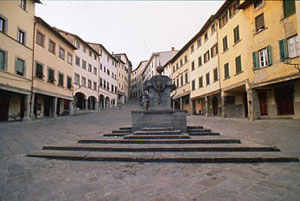 Ricordata in un documento del 1054, Stia appartenne ai conti Guidi del ramo di Porciano e fu per secoli il mercatale del castello omonimo. Sulle rive del torrente Staggia, il conte Baldino fece costruire una sontuosa abitazione, detta ‘Il Palagio’, da cui prese espansione un nuovo agglomerato che si aggiunse al villaggio già esistente a monte, denominato poi Stia Vecchia. Ebbe così inizio il ramo dei conti di Palagio, che mantennero il possesso della terra di Stia, sino all’assedio da parte della repubblica fiorentina (1402) e alla cacciata del conte Antonio, ultimo di questo ramo. Si costituì così il comune di Palagio Fiorentino, risultato dell’unione del comune di Montemezzano con le ville di Lontano, Papiano, Stia Vecchia e il Borgo di Stia. Nacque in questa terra il noto giurista e uomo politico Bernardo Tanucci (1698-1783), ministro alla corte di Carlo di Borbone e prezioso consigliere, poi, di Ferdinando V.Mentioned for the first time in a document dated 1504, Stia belonged to the Guidi Counts of the Porciano lineage, and was for centuries “the market place” of the castle bearing the same name. On the banks of the river Staggia, Count Baldino built a lavish home for himself called it “Il Palagio” from which a new urban settlement developed that attached itself to the already existing village above, and which was later called “Stia Vecchia” . It was then that the lineage of the counts of Palagio started here, a family line which held possession of Stia until the siege laid by the Florentine Republic (1402) led to the expulsion of the count Antonio, the last of that family line. As a result Stia was joined to several villages, namely Montemezzano, the Lontano villas, Papiano, Stia Vecchia and the Borgo of Stia, which were all united into one municipality called Palagio Fiorentino. Some famous people who were born in this town were Bernardo Tanucci (1698-1783), famous politician, jurist and a minister at the court of Carlo of Borbone, and in later times a precious adviser of Ferdinand V.
StazzemaStazzema
Comuni ott 6, 2009 Stazzema, che anteriormente al X secolo fu sotto la giurisdizione della curia lucchese, venne quindi ceduta in feudo, dal vescovo di Lucca Gherardo, ai visconti fra olmo, dai quali discesero quei nobili di Corvaia e di Vallecchia che governarono il paese nei secoli successivi. Dal 1254, anno in cui Lucca estese il proprio dominio in Versilia, Stazzema seguì le sorti della vicina Pietrasanta, finendo in potere di Firenze nel 1484, con tutta la sua vicaria. Venne elevato a capoluogo dell’alta Versilia nel 1776.Before the 10C Stazzema was under the jurisdiction of the curia of Lucca, after which the bishop of Lucca conceded it as a fief to the Fra Olmo viscounts, from whom the noble Di Corvaia and Di Vallecchia, who ruled over the area in following centuries, descended. From 1254, the year in which Lucca extended its dominion to Versilia, Stazzema followed the events of the near-by Pietrasanta, ending up under the power of Florence in 1484, together with all its vicarage.
SovicilleSovicille
Comuni ott 6, 2009 Il castello di Sovicille è ricordato dal 1004 fino alla metà del XII secolo come possedimento dell’abbazia della Serena. Nel XIII secolo era organizzato in comune con propri statuti ed era legato alla repubblica senese. Alcune famiglie del luogo affermarono nella seconda metà del Duecento signorie personali di breve durata. A metà del ‘300 il castello e il suo territorio apparivano comunque in declino, sia per le incursioni militari, sia per il dissesto del regime idrico del piano. Nel 1359 e nel 1391 fu assalito invano dai fiorentini. Restaurate nel XV secolo le sue mura, ebbe di nuovo assedi e guerre fino alle gravi devastazioni del primo Cinquecento. Una grave crisi demografica ed economica si ebbe nel 1630 quando Sovicille era entrato a far parte dello stato granducale toscano.The castle of Sovicille is recorded from 1004, and until the middle of the 12C was property of the abbey of the Serena. In the 13C it was organised into a municipality with its own statues and linked to the Republic of Siena. A number of local families held lordships over Sovicelle in the second half of the 13C, but these were all of short duration. In the mid 14C however, the castle and its territory suffered decline, in part due to military incursions, and partly due to damage of the irrigation system of the plain. In 1359 and in 1391 the Florentine´s attempt to assail the town was unsuccessful. The walls were restored in the 15C, but the town suffered sieges and wars until it was seriously devastated in the early 16C. The town also experienced a grave population and economic crisis in 1630 when it was under the grand-duchy of Tuscany.


